
Contact the following healthcare facilities directly:
MS Center Melsbroek
AZ Turnhout
Sint-Trudo Sint-Truiden
AZ Glorieux Ronse
AZ Jan Portaels Vilvoorde
Rehabilitation Hospital Inkendaal
26 June 2026
![Hires-Az Groeninge Jaarverslag-_DSC4649-2[1]](https://www.nexuzhealth.com/hs-fs/hubfs/Hires-Az%20Groeninge%20Jaarverslag-_DSC4649-2%5B1%5D.jpg?width=6016&height=4016&name=Hires-Az%20Groeninge%20Jaarverslag-_DSC4649-2%5B1%5D.jpg)

Patient safety is at the heart of every hospital's daily operations. Every day, vast amounts of patient information are captured in the centralised electronic health record (EHR). The challenge is not collecting that data, but making it easy to access, bringing the right information together, and ensuring it reaches the right healthcare professionals when they need it.
At az groeninge, that challenge is addressed by the Rapid Response Team (RRT). Originally established within intensive care, this specialised team supports nurses across the hospital whenever patients require closer observation or additional support.
"The main objective of our Rapid Response Team is patient safety," says Charlotte Van den Storme, Head of Intensive Care. "We want to provide nurses with accessible support and help them involve the right expertise as quickly as possible. Our role is not to take over responsibility, but to work together to provide the best possible care."
To support this approach, Nexuzhealth and az groeninge developed a dedicated digital RRT workflow within Nexuzhealth Hospital: CWS. Based on predefined search criteria, information already available in the centralised electronic health record is automatically brought together in a single worklist, giving the team faster access to the information needed for follow-up and support.
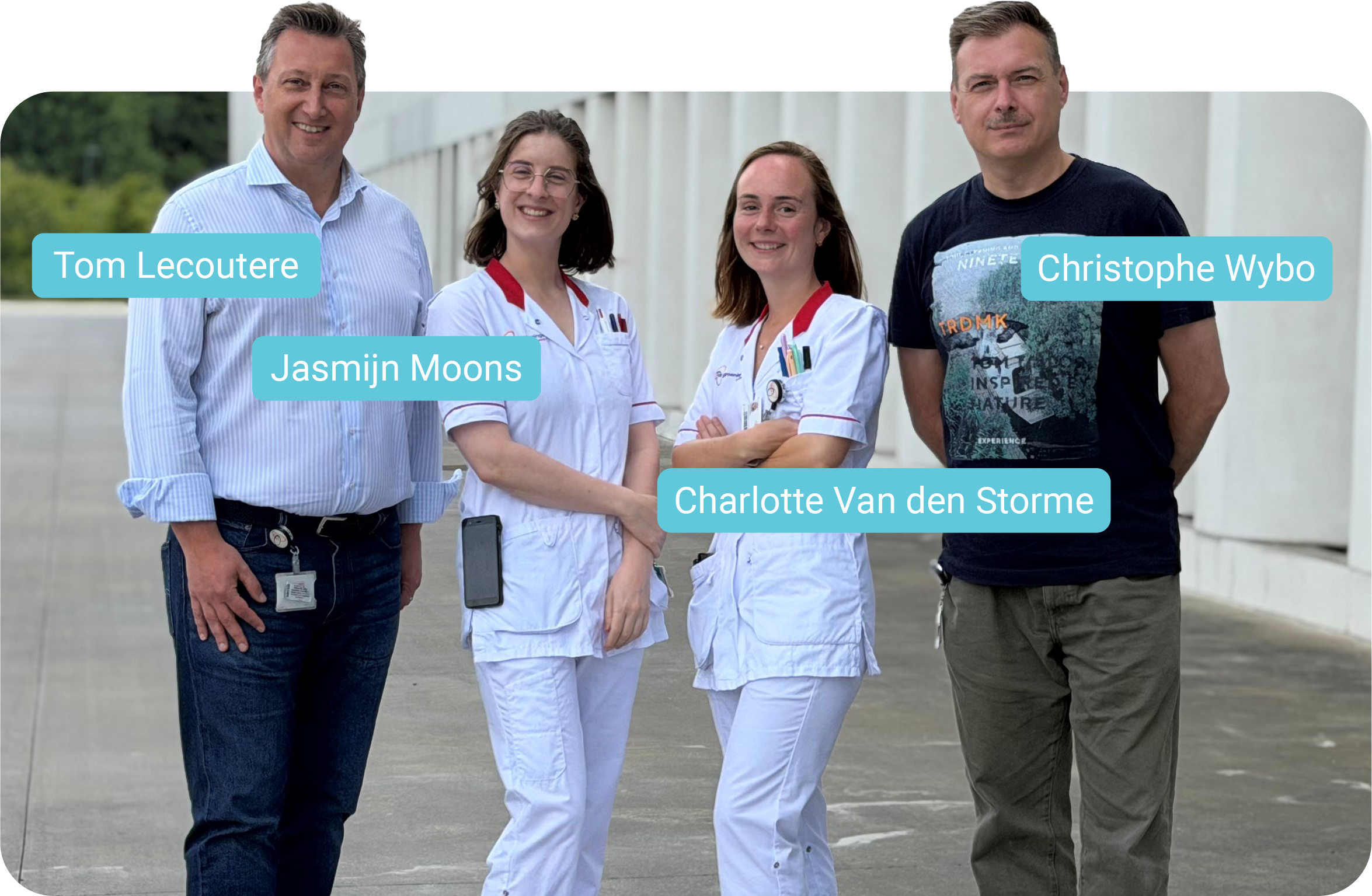
The driving forces behind the RRT workflow at az groeninge
The current workflow originated from a practical need. In its early days, the RRT relied on separate queries, lists and appointment books. Preparing for daily rounds required considerable effort. Patients had to be identified manually, information was spread across different locations, and relevant clinical data was not always available in one clear overview.
"In the past, we spent a significant amount of time simply locating the right patient," says Jasmijn Moons, Deputy Head Nurse of Intensive Care. "Each patient group or clinical parameter required a separate query. We worked with long lists containing a lot of information that was not always relevant, without having a clear overall picture. That made it much harder to determine which patients needed attention first."
Christophe Wybo recalls that preparation alone could sometimes take between thirty minutes and an hour before the team could even leave with the emergency response trolley. "Today, the workflow is completely different. The RRT opens the worklist and immediately sees which patients require attention and which actions are still outstanding."
“Patient safety is a strategic objective for our hospital. But a dashboard alone isn't enough. The approach has to be embraced by our teams and embedded in everyday clinical practice.”
![Groepsfoto RRT_liggend[1]](https://www.nexuzhealth.com/hs-fs/hubfs/Groepsfoto%20RRT_liggend%5B1%5D.jpeg?width=336&height=333&name=Groepsfoto%20RRT_liggend%5B1%5D.jpeg)
Manager care-related IT, az groeninge
Over the years, az groeninge has invested heavily in the digitalisation of patient information. Thanks to connected multi-parameter monitoring devices and structured clinical documentation, an increasing amount of information now flows directly into Nexuzhealth Hospital: Clinical Workstation (CWS).
While this has made far more data available, it has also introduced a new challenge: how do you present all that information in a clear and practical way for teams responsible for monitoring dozens of patients every day?
The digital RRT workflow addresses this by automatically running predefined searches on data already available in the centralised electronic health record. The results are then brought together in a single, central worklist.
From this worklist, healthcare professionals can navigate directly to the relevant patient information. The ISBAR structure has also been integrated, allowing information to be reviewed and shared in a consistent, standardised way.
"The automated worklist helps us find relevant information much more quickly," says Tom Lecoutere, Manager Care-related IT at az groeninge. "Patients who meet predefined criteria are automatically grouped into one overview. Assessing the information, interpreting it and deciding on any follow-up actions always remains the responsibility of the Rapid Response Team and the healthcare professionals involved."
Using dedicated registration buttons, the team can document follow-up, telephone advice, reporting and interventions in a structured way. This makes it immediately clear which actions have already been completed and which follow-up activities are still planned.
"The EHR is our patient cockpit, Everything that is clinically relevant should come together there. From the worklist, the Rapid Response Team can immediately access the right patient information, record actions and monitor follow-up. Without that central foundation, you would simply end up working with fragmented solutions again."
![Groepsfoto RRT_liggend[1]-1](https://www.nexuzhealth.com/hs-fs/hubfs/Groepsfoto%20RRT_liggend%5B1%5D-1.jpeg?width=377&height=388&name=Groepsfoto%20RRT_liggend%5B1%5D-1.jpeg)
Implementation Consultant/Configurator EHR at az groeninge
Before |
Today |
| Patients were monitored using separate queries and lists. | The RRT works from a single central worklist. |
| Identifying relevant patients required extensive manual checks across multiple lists. | Patients matching predefined search criteria are automatically brought together. |
| Information was scattered across different locations. | Healthcare professionals can access relevant patient information directly from the workflow within the centralised electronic health record. |
| Follow-up was sometimes prepared on paper. | Actions, reporting and follow-up are documented in a structured way. |
| Maintaining an overview relied heavily on individual vigilance and experience. | The workflow supports a more consistent approach across the entire hospital. |
In day-to-day hospital operations, efficiency has a direct impact. By spending less time searching, checking and preparing, the RRT can devote more time to targeted follow-up, multidisciplinary consultation and supporting clinical teams on the ward.
“Time is one of the scarcest resources in healthcare. The less time you spend searching through administrative information, the more time you can dedicate to what truly matters: caring for patients. That's the real value of this way of working.”
![Groepsfoto RRT_liggend[1]-2](https://www.nexuzhealth.com/hs-fs/hubfs/Groepsfoto%20RRT_liggend%5B1%5D-2.jpeg?width=370&height=362&name=Groepsfoto%20RRT_liggend%5B1%5D-2.jpeg)
Deputy Head Nurse, Intensive Care, az groeninge
A Rapid Response Team can only deliver its full value when it is embraced across the hospital. AZ Groeninge recognised this from the outset. The team needed to be approachable, visible on the wards and seamlessly embedded in nurses' day-to-day practice.
"From the very beginning, it was important that the Rapid Response Team wasn't perceived as an extra layer of control," says Charlotte Van den Storme. "Patients remain under the responsibility of their own ward. We're there to support, advise and coach whenever needed. That approachable way of working was essential in building trust and making the RRT a natural part of everyday hospital practice."
For that reason, AZ Groeninge invests not only in the digital workflow itself, but also in training and continuous feedback. RRT nurses receive coaching on communication and managing resistance to change. Nurses throughout the hospital are trained in clinical reasoning, with the added value of the RRT forming an integral part of that programme. Real-life cases are regularly reviewed to encourage continuous learning. Together, these elements strengthen the overall approach. Technology can identify signals, but it is the organisational culture that determines how effectively those signals are recognised and translated into action.
The collaboration around further development has also become more structured over time. While the RRT workflow evolved organically in its early years, improvements are now managed through a structured project approach. Requests, enhancements and new functionalities are systematically reviewed, tested and validated through the close collaboration between AZ Groeninge and Nexuzhealth. This ensures that both the modules and their ongoing development continue to reflect the realities of daily practice.
For az groeninge, the RRT workflow forms part of a broader commitment to quality. The hospital has been awarded the Joint Commission International (JCI) accreditation for the fifth consecutive time, an internationally recognised benchmark for quality and patient safety.
Today, the digital RRT workflow gives az groeninge greater control over its day-to-day operations. The team works from a single central worklist, gains faster access to relevant patient information, and can document and monitor actions more effectively. As a result, less time is spent on searching and preparation, leaving more time for clinical assessment, multidisciplinary consultation and supporting colleagues on the ward.
"We've invested in this for many years," says Charlotte Van den Storme. "Today, we have a well-established system that supports a wide range of activities across the hospital and delivers clear benefits. But it's equally important to keep identifying opportunities, refining the approach and continuing to improve. Healthcare never stands still, so neither should the technology or the way we work."
Az groeninge continues to develop the RRT workflow in close collaboration with Nexuzhealth. Requests, enhancements and new functionalities are systematically reviewed, tested and validated, ensuring that the digital workflow continues to meet the practical needs of the Rapid Response Team.
"For us, the real value lies in having a solution that evolves alongside the way we work," says Tom Lecoutere. "Over the years we've been able to refine exactly what the Rapid Response Team needs to work faster, more effectively and more safely. That's what makes technology genuinely valuable in everyday clinical practice."
At the same time, az groeninge is already looking ahead. Biosensors, telemonitoring and broader patient monitoring beyond the hospital walls are becoming increasingly important. Here too, the hospital sees opportunities to give healthcare professionals efficient access to relevant information and to provide even better support for patient follow-up.
Through its Rapid Response Team, az groeninge demonstrates how patient safety, digital support and clinical practice can reinforce one another. Not by adding technology on top of existing processes, but by ensuring digital solutions are built around what healthcare professionals need every day: a clear overview, confidence, efficiency, and the right information at the right moment.
One digital health record for better healthcare
Make a difference
Our experts are ready to brainstorm with you about how Nexuzhealth can make a difference within your organization.
MS Center Melsbroek
AZ Turnhout
Sint-Trudo Sint-Truiden
AZ Glorieux Ronse
AZ Jan Portaels Vilvoorde
Rehabilitation Hospital Inkendaal