





Contact the following healthcare facilities directly:
MS Center Melsbroek
AZ Turnhout
Sint-Trudo Sint-Truiden
AZ Glorieux Ronse
AZ Jan Portaels Vilvoorde
Rehabilitation Hospital Inkendaal

Diagnostics
Diagnostics
Diagnostics

Diagnostics
Diagnostics
Diagnostics
Operations

Operations

Operations

Engagement

Engagement
Engagement
Manage administrative and clinical patient information directly in the LIS. From identification and contact details to admissions and relevant medical information, all data required for laboratory testing remain available throughout the laboratory process.
Access patient information through a clear and user-friendly interface. Staff can quickly view the available patient data, ensuring they work with the right information throughout the laboratory process.
Keep patient data automatically up to date through an Admission, Discharge, Transfer (ADT) integration with the hospital information system. Information on admissions, discharges and transfers is synchronised with the LIS, eliminating the need for manual entry and helping data remain consistent.
Work with centralised patient information across multiple laboratories, disciplines and locations. Authorised laboratories within one healthcare organisation use the same patient data, while only one ADT integration with the hospital information system is required. This helps avoid duplicate records and simplifies collaboration between laboratories.
Create, manage and track laboratory orders from the LIS. This gives your laboratory a clear overview of all requested tests, their status and the steps still to be completed.
Register orders manually or receive them digitally via e-ordering. Requests can, for example, originate from an electronic health record, GP software or an external ordering platform. This reduces duplicate data entry and lowers the risk of errors.
Define the type of sample required for a test (including the biological material and compatible containers). Upon receipt, the sample is registered and linked to the correct patient, order and tests. This keeps it clear which material belongs to which test.
Correctly identify samples using barcode and label management. Nexuzhealth Lab supports containers that are pre-labelled with a barcode, but can also generate labels itself. This allows samples to be tracked accurately throughout the entire laboratory process.
Define which tests are available and how they should be performed. Requested tests are linked to the correct sample, registered and tracked during execution. This keeps the process from request to result controlled.
Organise sample management centrally across different laboratory disciplines and locations. Samples can be exchanged more easily between laboratories without losing the link to the original patient, order or test.
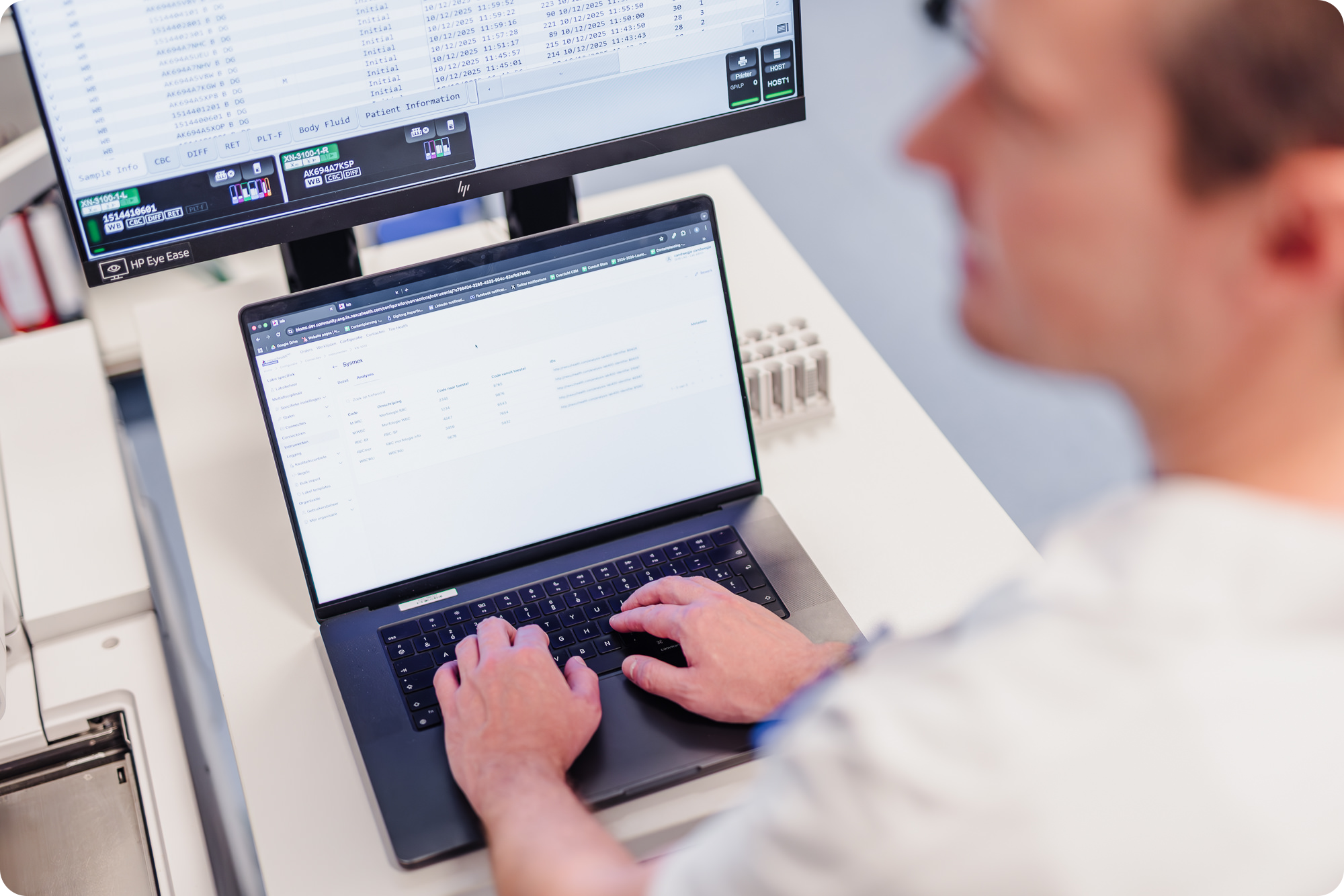
Connect different types of laboratory equipment to the LIS. Nexuzhealth Lab can integrate with simple standalone analysers, connected instruments and fully automated laboratory lines. This allows equipment to be controlled and monitored from one central system.
Integrate middleware and specialised software into laboratory operations as well. This includes applications for microbiology, genetics or digital pathology. Specialised processes therefore remain connected to the laboratory’s overall workflow.
Connect different types of laboratory equipment to the LIS. Nexuzhealth Lab can integrate with simple standalone analysers, connected instruments and fully automated laboratory lines.
Add equipment more quickly or replace existing instruments with less impact on the rest of the LIS. Because the technical translation is managed in separate drivers, the entire laboratory workflow does not need to be adapted each time. This can reduce implementation time and costs.
Connect local laboratory equipment to the cloud platform via the locally installed Lab Gateway. The gateway supports fast communication and temporarily buffers data if the network connection is interrupted. Once the connection is restored, data are synchronised automatically, helping prevent results from being lost and minimising additional manual follow-up.
Register and manage QC materials directly in the LIS. The laboratory can define the type of control material, expected values, permitted ranges, lot numbers and validity periods, among other parameters. This ensures quality controls are followed up in a structured way.
Process and assess measurement results from QC materials in the LIS. By comparing measured values with configured standards, the laboratory can verify whether instruments and analytical methods are functioning correctly and consistently.
Follow up on abnormal QC results when values fall outside the permitted limits. Staff can investigate the cause, record corrective actions and verify that the issue has been resolved before patient results are released.
Support quality control even when no commercial QC material is available. Known patient samples can be converted into in-house QC material for subsequent tests. Nexuzhealth Lab makes it possible to register this transparently and traceably in the LIS.
Receive results automatically from connected analysers or enter them manually for less automated tests. Nexuzhealth Lab therefore supports both highly automated workflows and processes in which manual assessment or registration is still required.
Record results using predefined fields and a consistent structure. This way of working is integrated into the LIS work screens and helps ensure reports are complete, consistent and easy to read.
Ensure results pass through the appropriate validation steps before release. Nexuzhealth Lab supports technical, clinical or biological validation according to the configured workflow, permissions and responsibilities within the laboratory.
Automatically send validated results to the appropriate recipients. Once the required validation steps have been completed, the LIS can deliver results to requesting physicians according to the laboratory’s configured rules for timing, recipients and delivery method.
Share results electronically and in real time with requesting physicians and healthcare systems. Using HL7 FHIR, APIs and medical coding systems such as LOINC, SNOMED CT and UCUM, data can be interpreted consistently by systems and healthcare professionals.
In addition to structured data exchange, generate traditional PDF reports. These reports follow the laboratory’s predefined templates and visual identity, ensuring external physicians receive a recognisable and clear document.
Bring together results and findings from different laboratory disciplines in a single report. Each discipline retains its own validation responsibility and accreditation requirements. The physician or patient receives one complete overview instead of multiple separate reports.
Make laboratory data more widely usable by storing results in a structured format. These data can later be used for analysis, quality improvement, research and AI-supported applications. This is more difficult when information is only available as free text or PDF.
Define how completed services should be processed before invoicing. Pre-invoicing rules determine, for example, which tests are billable, how services are grouped and which data must be passed to the invoicing system.
Let the LIS compile preparatory invoicing documents based on registered services. These documents provide an overview of the services delivered and can be checked and corrected before final invoicing.
Transfer approved pre-invoicing data electronically to the invoicing or financial software in use. This eliminates the need to re-enter information manually and reduces the risk of missing or incorrectly invoiced services.
Pre-invoicing prepares the final invoicing process but does not necessarily generate the final invoice itself. The feature ensures that delivered services can be passed on to the invoicing system correctly and completely.
Coordinate the entire laboratory process from a central workflow engine. From receiving a sample and communicating with instruments to producing and releasing the result, Nexuzhealth Lab helps ensure tasks are performed and followed up at the right time.
Configure laboratory processes based on the way your laboratory operates. Individual procedures can be managed separately and then combined into complete workflows. This allows the LIS to be adapted to practice without forcing the laboratory into one fixed way of working.
Continuously track the stage of a record, sample or task. The workflow engine supports parallel execution, detects errors and can retry failed steps. This reduces manual follow-up and provides better visibility into progress.
Build workflows in a visual editor without writing software code. Administrators can configure process steps, decision points, conditions, routing and shared pathways without requiring custom development or a new release each time.
Configure processes in detail, for example by tissue type or test. Staff can follow predefined standard protocols, while authorised laboratory professionals and specialists can deviate from them when the practical situation requires it.
Manage processes across different laboratories and locations from one dashboard. Your organisation determines which steps are performed locally and which are centralised. Nexuzhealth Lab then coordinates transfer and logistics between the locations involved.
Automate actions based on configured events, conditions and rules. For example, when a label is printed or a process step is completed, the LIS checks whether specific conditions have been met and automatically performs the appropriate action.
Examples include: automatically moving a record to the next step; initiating additional tests based on initial findings; applying context-specific decision support; performing safety checks before a result is released.
Record important actions throughout the LIS using audit logging. From data entry and changes to validation, sample tracking and automated system actions, it remains visible what happened, when it happened and who or which process performed the action.
Role-based access control allows your organisation to determine which staff members may view, modify or validate specific data. Nexuzhealth Lab therefore supports traceability, security, quality management and ISO 15189 accreditation.
Record where each sample is stored, such as a specific refrigerator, freezer, cabinet, rack, drawer or position. This keeps the sample’s physical location linked to the digital record.
Search the LIS to find where a sample is located. This helps staff when a sample is needed again for additional testing or when it cannot immediately be found in the expected location.
Record all actions involving a sample in the audit log. This applies both to actions performed by staff and to automatically executed system actions. It therefore remains visible what happened to the sample, when it happened and who or which process performed the action.
Use audit logs not only as technical evidence but also as a practical tool in day-to-day operations. Staff can search the audit history to quickly reconstruct where a sample has been, which steps it has gone through and where something may have gone wrong.
Maintain a clear chain of traceability for the sample, even after it has been processed or stored. This reduces the risk of material being difficult or impossible to locate when it is needed again later.
Monitor the laboratory’s key operational, clinical and quality indicators through clear dashboards. This allows staff and managers to identify trends, performance and potential bottlenecks more quickly.
Run statistical queries and analyses as background tasks. This allows larger volumes of data to be processed without noticeably slowing down day-to-day laboratory operations or active users.
Build reports without writing code. Users can respond independently to new information needs without having to involve a developer or software supplier for every analysis.
Combine and filter data according to different criteria, such as period, quantities and volumes, patient, prescriber, quality, financial data or outsourced tests. The same data source can therefore be analysed from different operational or clinical perspectives.
Save custom reports as templates. Users can run the same analysis again later without having to reconfigure all filters and settings.
Export reports to Excel or CSV for further analysis. Data can also be imported into external business intelligence platforms, allowing the laboratory to continue working with its existing analytics tools.
Make laboratory data available to external applications through documented OpenAPI integrations. Clinical data can be used via an HL7 FHIR R4 API in a standardised, machine-readable format for reporting, advanced analytics and future AI-supported applications. Access is designed with GDPR and EHDS requirements in mind.
Make laboratory information available through Mynexuzhealth, the trusted patient portal within the Nexuzhealth ecosystem. This means patients do not need to use a separate platform to access relevant laboratory data.
Make validated laboratory results and accompanying reports digitally available to patients as soon as they may be released. This gives patients easier access to medical information and strengthens their involvement in their own care journey.
Allow patients to request certain laboratory tests through the portal where permitted by local laws and regulations. The request is sent directly to the laboratory, allowing patient-initiated requests to be incorporated digitally into the laboratory process.
Exchange data in real time with hospital information systems, electronic health records and other healthcare applications. Nexuzhealth Lab therefore acts as a connecting link between the laboratory and the wider healthcare network.
Automatically receive administrative patient data and information on admissions, discharges and transfers in the LIS. This ensures that the laboratory and the healthcare professionals involved have consistent and up-to-date patient information.
Synchronise test catalogues and healthcare professional data between connected systems. Changes therefore do not need to be entered or maintained separately in each system, helping reduce duplicate registration.
Allow physicians and other healthcare professionals to request laboratory tests digitally from their own working environment, for example from an electronic health record or e-ordering application. The request is automatically transferred to the LIS, reducing manual registration and helping the diagnostic pathway run more smoothly.
Send validated results and reports electronically back to the requesting physician’s system. This allows healthcare professionals to access laboratory information directly within their own working environment.
Support data exchange with reference laboratories and satellite laboratories. Orders, samples and results from outsourced tests can be tracked digitally without losing oversight of the diagnostic process.
Pass data on completed services to the relevant administrative or financial systems. Nexuzhealth Lab therefore supports smooth further processing of billing.
Exchange information consistently using standards such as HL7 v2.x, FHIR, IHE and REST APIs. This reduces manual data entry, lowers the risk of errors and helps safeguard data integrity throughout the diagnostic pathway.
Organise different laboratory disciplines and locations within a single LIS. Clinical biology, microbiology, anatomical pathology, clinical genetics and other disciplines therefore do not necessarily need to work with completely separate systems.
Your organisation determines which data and processes are shared and which remain restricted. Flexible role-based authorisation takes into account the user’s role as well as department, discipline or location.
Manage or synchronise patient data centrally within your own organisation. Authorised laboratories, disciplines and locations therefore work with the same patient information without requiring separate registrations for each laboratory.
This reduces duplicate patient registrations and gives the laboratories involved a more consistent overview within their own operations.
Process requests containing tests for multiple laboratory disciplines as a single order. An order may, for example, originate from an electronic health record or ordering system. The workflow engine then distributes the individual components to the appropriate laboratories while retaining the original multidisciplinary order.
Exchange samples more easily between laboratories, disciplines and locations. The LIS retains a central identification or links different discipline-specific identification numbers to the same sample. Each discipline can also record its own sample characteristics.
All transfers and actions are recorded through audit logging. This keeps the entire chain traceable, even when a sample passes through multiple laboratories, disciplines or locations.
Configure processes involving multiple laboratories or disciplines as one standardised workflow. The workflow engine distributes orders and samples to the appropriate departments and monitors progress across the entire pathway. This allows your organisation to maintain an overview even when individual steps are carried out at different locations.
Bring together results and findings from different laboratory disciplines in one complete report. Each discipline validates its own tests in accordance with the applicable responsibilities and accreditation requirements. The physician or patient receives one coherent overview instead of multiple separate reports. This reduces fragmentation and lowers the risk of errors or misinterpretation.
Curious how Nexuzhealth makes a difference for your laboratory?
Our experts are ready to assist you with a customized demonstration.
Please note: patients cannot request a demo via our website. This is only possible for professionals. Patients can visit our FAQ or our service desk for more information.

MS Center Melsbroek
AZ Turnhout
Sint-Trudo Sint-Truiden
AZ Glorieux Ronse
AZ Jan Portaels Vilvoorde
Rehabilitation Hospital Inkendaal